
Three Principles for Navigation
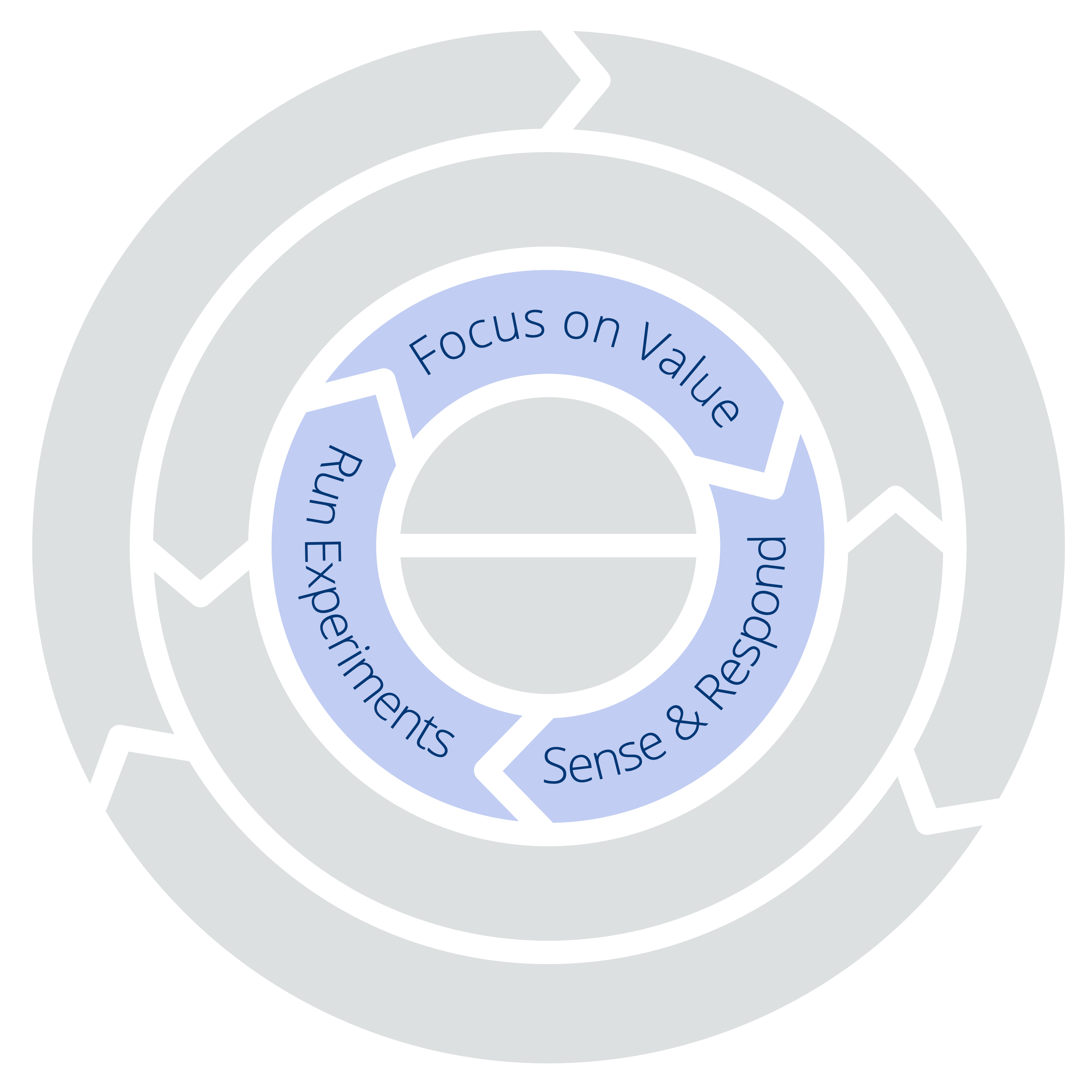
Principle 3 — Focus on Value
Focus your daily work on value delivery, so that the stuff that needs doing to achieve your purpose is done.
Essential patterns to help you achieve this:
- Clarify and Develop Domains — Clarifying the area of influence, activity and decision-making that a team or person in a role is responsible for enables them to understand the value they are expected to deliver.
- Respond to Organizational Drivers — Ensuring people in the organization respond to relevant impediments and opportunities maximizes an organization’s potential for creating value.
- Prioritize Backlogs — When you prioritize your list of work items by value, it is obvious which ones need to be worked on first.
- Limit Work In Progress — Limiting the number of concurrent work items for people and teams helps to maintain a steady flow of value and encourages collaboration when work is blocked.
- Daily Standup — A Daily Standup provides the space for a team to organize how they will create value during the day ahead.
- Test Arguments Qualify as Objections — Considering whether or not arguments brought forward against a decision reveal worthwhile improvements or unwanted consequences supports keeping your decision-making focused on value and avoids getting derailed by unfounded opinions and personal preferences.
Principle 4 — Sense & Respond
Identify, prioritize and respond to impediments and opportunities, so that you can adapt or pivot as necessary and improve where you can.
Essential patterns to help you achieve this:
- Continuous Improvement of Work Process — Getting in the habit of continuously seeking to improve the work process supports people’s skill in identifying and acting on opportunities to improve.
- Describe Organizational Drivers — Before acting on a perceived impediment or opportunity, it is essential to understand the situation and establish that it makes sense for the organization to address it.
- Determine Requirements — Agreeing on the general direction and scope of response to an impediment or opportunity first, supports effective decision-making about what specifically to do.
- Governance Backlog — Keeping a prioritized list of all impediments and opportunities that require a governance decision to be made keeps outstanding issues visible and clarifies what is most important to respond to first.
- Navigate via Tension — When everyone in the organization pays attention for situations that appear different to what is expected or desired, and brings that information to the attention of those responsible, you maximize the organization’s potential for identifying impediments and opportunities.
- Respond to Organizational Drivers — Responding only to challenges and opportunities that are valuable for the organization maximizes return on investment of the limited time, energy, and resources you have available.
Principle 5 — Run Experiments
Run experiments to address complex challenges, so that you learn how to move closer to where you want to be.
Essential patterns to help you achieve this:
- Describe Organizational Drivers — Building a shared mental model of the situation you want to address is essential for successfully designing, running, and later on evaluating experiments.
- Determine Requirements — Clarifying the requirement is a prerequisite for designing the experiment, and for determining metrics for success.
- Define and Monitor Metrics — Defining clear criteria for determining success before the start of an experiment, helps to reveal flaws in its design and supports effective evaluation of outcomes.
- Consent Decision-Making — An effective group process for viewing a proposition from a diversity of perspectives, and for testing whether or not an experiment is good enough and safe enough to run.
- Evaluate and Evolve Policies — An experiment needs to be regularly reviewed to determine what outcomes it achieves, and, as a consequence, potentially adapted, or even stopped.
- Limit Work in Progress — Limit the number of concurrent experiments to avoid overwhelm and maintain a steady flow of value.
- Create A Pull System for Organizational Change — Inviting and enabling people to run experiments when they discover organizational requirements supports an effective and decentralized approach to organizational development.

 Read next: Two Principles for Structure