
Record Governance Decisions
Governance decisions are significant interventions — either for the organization as a whole or for specific people or domains — that include deciding which drivers to address, which requirements to fulfill, in which order, and what policies or other agreements are needed to fulfill them.
While recording governance decisions might initially appear to be an overhead, there are numerous benefits to being able to recollect and review what has been decided and why over time:
- Improved transparency and trust by making decisions and rationales visible
- Increased accountability by making it easier to track decisions, who made them, and on what basis
- Provide access to important information people need to do their work effectively
- People better understand their own and others’ commitments and responsibilities
- More effective onboarding of new members
- More coherent execution of agreements within and across teams
- Ensures continuity and coherence in decision-making by offering a source of reference for future decisions
- Easier to identify dependencies between decisions, roles, and domains
- Better evaluation of outcomes and adaptation of agreements
- Reduces the potential for misunderstanding later about the details of agreements, including the reasons why they are made
Whether you are making governance decisions alone or with a team, and whether those decisions affect only yourself (e.g., as an individual in a role) or others as well, it’s still worthwhile recording them.
Keep an up-to-date record of all governance decisions in a shared logbook or equivalent register.
For guidance on what to record for drivers and requirements, see the patterns Describe Organizational Drivers and Determine Requirements.
Recording Policies
A policy is an intervention that is created and evolved through governance; a process, procedure, protocol, plan, strategy, or guideline.
Record policies with adequate detail so that important information can be recalled later.
At the very least, include:
- A summary of the overall purpose of the policy
- The intended outcome of the policy
- A description of the agreed intervention in adequate detail so that it can be understood, implemented, and reviewed
- Who is responsible for what
- review date, relevant metrics, and how they will be monitored.
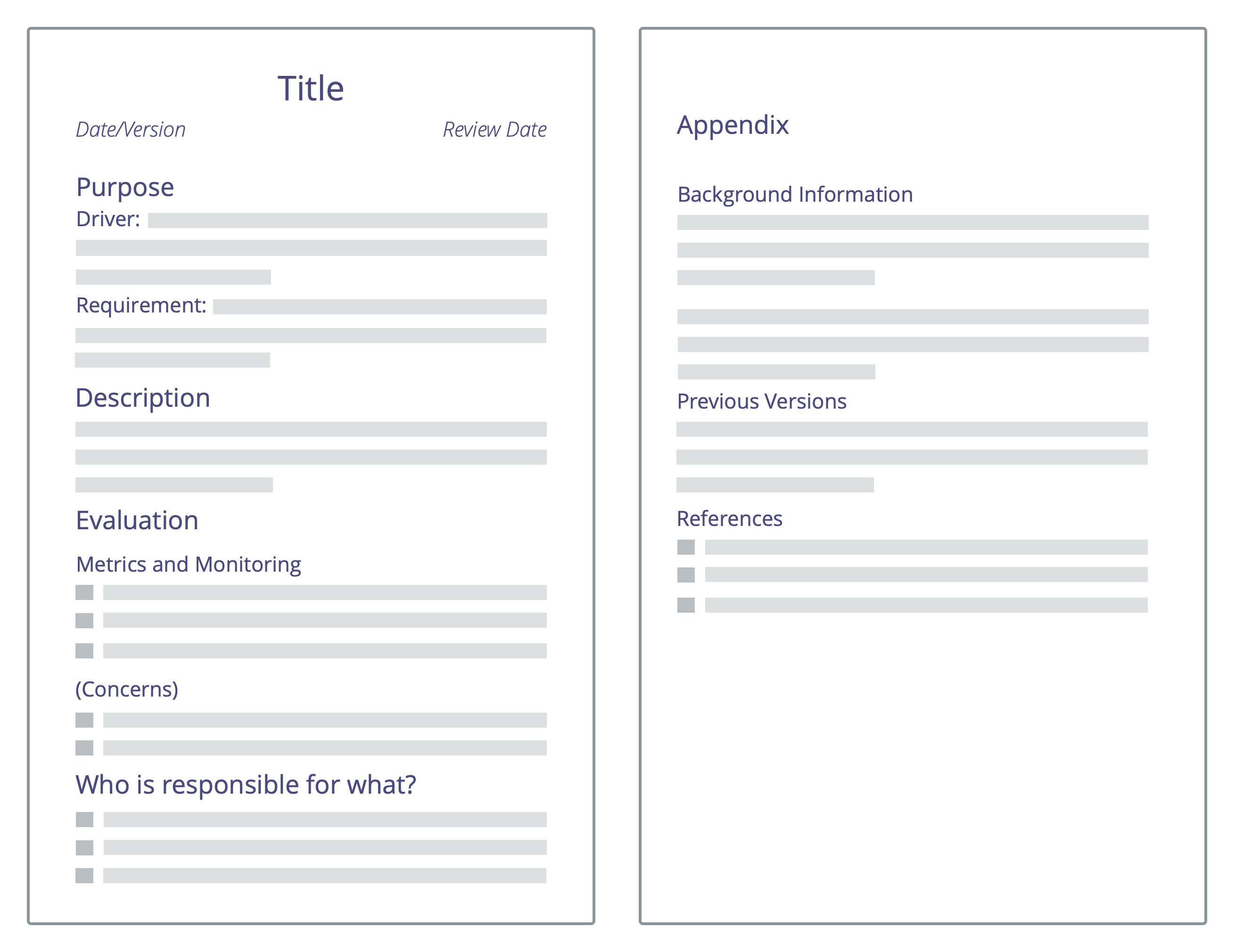
Depending on the scope and significance of the policy, consider including all of the following:
- A title for the policy
- Date of creation (or version)
- Date of expiry or due date (if relevant)
- The purpose (driver and requirement)
- A description of the policy itself, which often includes one or more of these aspects:
- Any relevant sub-purposes and the associated interventions
- Specific activities and or constraints
- Specific deliverables, the purpose they should fulfill, and for whom
- Rationale for why aspects of the overall decision were made (in case it would otherwise be unclear)
- Allocated and or available resources
- Standard constraints that are relevant to keep in mind that might otherwise be overlooked by those with responsibility for execution or compliance
- Evaluation
- Metrics and Monitoring
- Evaluation Schedule
- Information about any concerns
- Who is responsible for what?
- E.g., who will oversee the execution of the policy, who will execute each specific part of the policy, or who needs to adhere to the policy
- Monitoring metrics and or acting when targets are unmet
- Appendix (if helpful)
- Background information
- Previous versions of the policy and purpose
- References
Recording Day-to-Day Agreements
While all decisions of significance are worth recording so that they can be remembered, reviewed, and evaluated over time, sometimes it’s beneficial to record less significant decisions as well, although in most cases, far less information is required. For example:
- A task to complete
- A note of who will take responsibility for a specific task, and by when
- An appointment in a team calendar

 Read next: Describe Deliverables