
Planning and Review Meetings
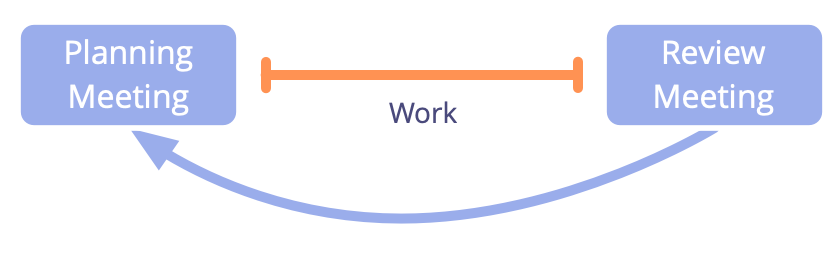
Planning and review meetings serve as essential feedback loops in iterative work processes, providing a structured environment for teams to align on objectives, agree on work for the next iteration (or “sprint”), evaluate progress, and make necessary adjustments.
Both meetings rely on a well-maintained product backlog: The outcome of a planning meeting is the iteration backlog with items the team is confident they can deliver by the end of the iteration. In contrast, the outcome of the review meeting is a revised, prioritized, up-to-date product backlog that is ready for the next planning meeting.
While the planning meeting is typically limited to team members, the review meeting includes relevant stakeholdersbecause they would be best placed to accept completed work items and can provide valuable feedback that might lead to new items in the backlog, as well as changes in priority.
Planning Meeting
Time-box the meeting to stay on track (typically 1-2 hours per week of iteration).
- Review the product backlog and select work items for the next iteration (the “iteration backlog”) by considering available capacity, estimated effort, priority, and dependencies.
- Prioritize the iteration backlog and, if possible, identify the overall objective for the upcoming iteration.
- Address any clarifying questions.
- Make a plan for handling the iteration backlog, including how you will handle any dependencies between the individual items.
Review Meeting
Time-box the meeting to stay on track (typically 1 hour per week of iteration). Schedule any conversations requiring a significant amount of time for after the meeting.
- Report which items in the iteration backlog have been completed and which are still unfinished.
- Share insights on what worked well and where improvements may be required. (Add those to the agenda for a Retrospective meeting, but refrain from attempting to deal with them in the Review meeting, which should maintain focus on reviewing the actual work).
- Demonstrate or review the completed items and decide if they adequately fulfill the related requirement or require rework (if not already done as preparation for the review).
- Celebrate successes, identify new insights, and add new items to the product backlog.
- Hear any reports from stakeholders on changes in the environment or regarding priorities.
- Review the product backlog, adjust priorities if necessary, and clarify any expectations relating to the delivery of specific items.
- Update the backlog based on outcomes and insights, prioritizing accordingly.

 Read next: Coordination Meeting