
Circle
Circles are a type of team that provides a mechanism for more effective collaboration by distributing responsibility for governance throughout an organization.
A circle’s members work together toward a common purpose: They share responsibility for a specific domain and are entrusted with the formal authority to govern and operate within the constraints of that domain in order to achieve their common purpose.
Members continuously decide together what to do to account for their domain, and set constraints on how and when things will be done. To that end, they maintain and evolve a body of policies. All members of a circle are equally accountable for work and governance within the circle’s domain.
While not every team needs to be a circle, in general, circles enable faster and more effective decision-making, increase self-accountability and engagement, and therefore improve an organization’s capacity to navigate complexity and respond promptly to changing circumstances.
Establishing circles enables greater autonomy and fosters co-responsibility for achieving outcomes and improving how work gets done.
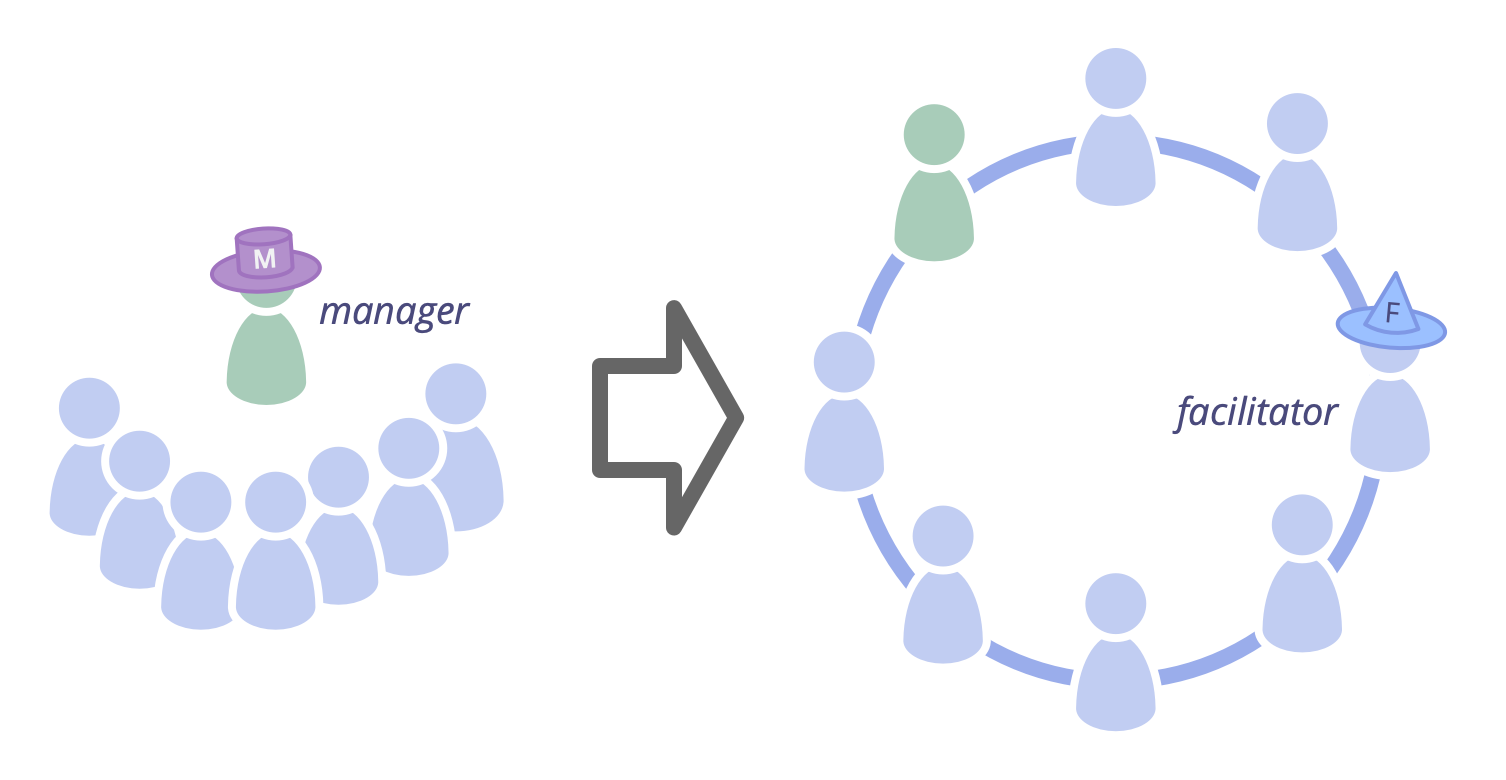
A circle’s members work best when their domain is defined in a way that eliminates unnecessary and unhelpful dependencies that get in the way of creating and delivering value effectively.
Circles may be permanent or temporary and can be composed of individuals holding specific roles or working together as a team.
Semi-Autonomous and Self-Governing
A circle is semi-autonomous because its members act within the boundaries of their domain, including any external constraints. It is also self-governing to a degree: members have explicit authority to decide how to fulfill the purpose of their domain, provided they remain within any explicitly defined limits. Their authority for governance covers everything explicitly granted, plus everything not explicitly forbidden by broader organizational policies.
The scope of authority for governance often includes responsibility for deciding specifics for how governance is handled, deciding how work is organized and done, improving work processes, and supporting ongoing professional development, with the necessary time and resources allocated for doing so.
A circle’s members typically have the authority to distribute their responsibilities amongst themselves. They may also have the authority to delegate some of their responsibilities to others in the organization or even to recruit new people when needed.
Note: In the context of agile methodologies, teams are often loosely described as self-organizing. However, this term does not distinguish between operations and governance. Being explicit about a team’s area of authority relating to governance makes expectations explicit, reduces misunderstanding, and prevents various stakeholders from overstepping boundaries by clarifying who is responsible for what.
Equivalence
All members of a circle are considered equivalent in the governance of the circle’s domain, within the constraints defined by their delegator. Each has equal opportunity to participate in making and evolving decisions that define how the circle functions.
Together, a circle’s members share the responsibility for setting objectives and defining or evolving policies that guide their work. They also share responsibility for ensuring that the decisions they make and the activities that follow are in alignment with broader organizational objectives and coherent with wider organizational policies.

Responsibilities of a Circle’s Members
- Collaborate to fulfill the domain’s purpose.
- Contribute towards developing and evolving policies for improving effectiveness in fulfilling the domain’s purpose.
- Ensure transparency and accountability for decisions and actions.
- Regularly evaluate the design and scope of their domain, and when helpful, collaborate with the delegator to improve its effectiveness.
- Support one another’s development and contribute to the ongoing development of the circle as a cohesive and effective team.
Associated Patterns
- Clarify and Develop Domains — for defining the scope and authority of the circle.
- Linking and Double Linking — for connecting circles and enabling information flow and influence.
- Role Selection — for assigning specific responsibilities within the circle.
- Evaluate and Evolve Policies — to continuously improve how the circle operates.
- Consent Decision Making — for making decisions together.
- Proposal Forming — for collaborating on creating proposals. \

 Read next: Role